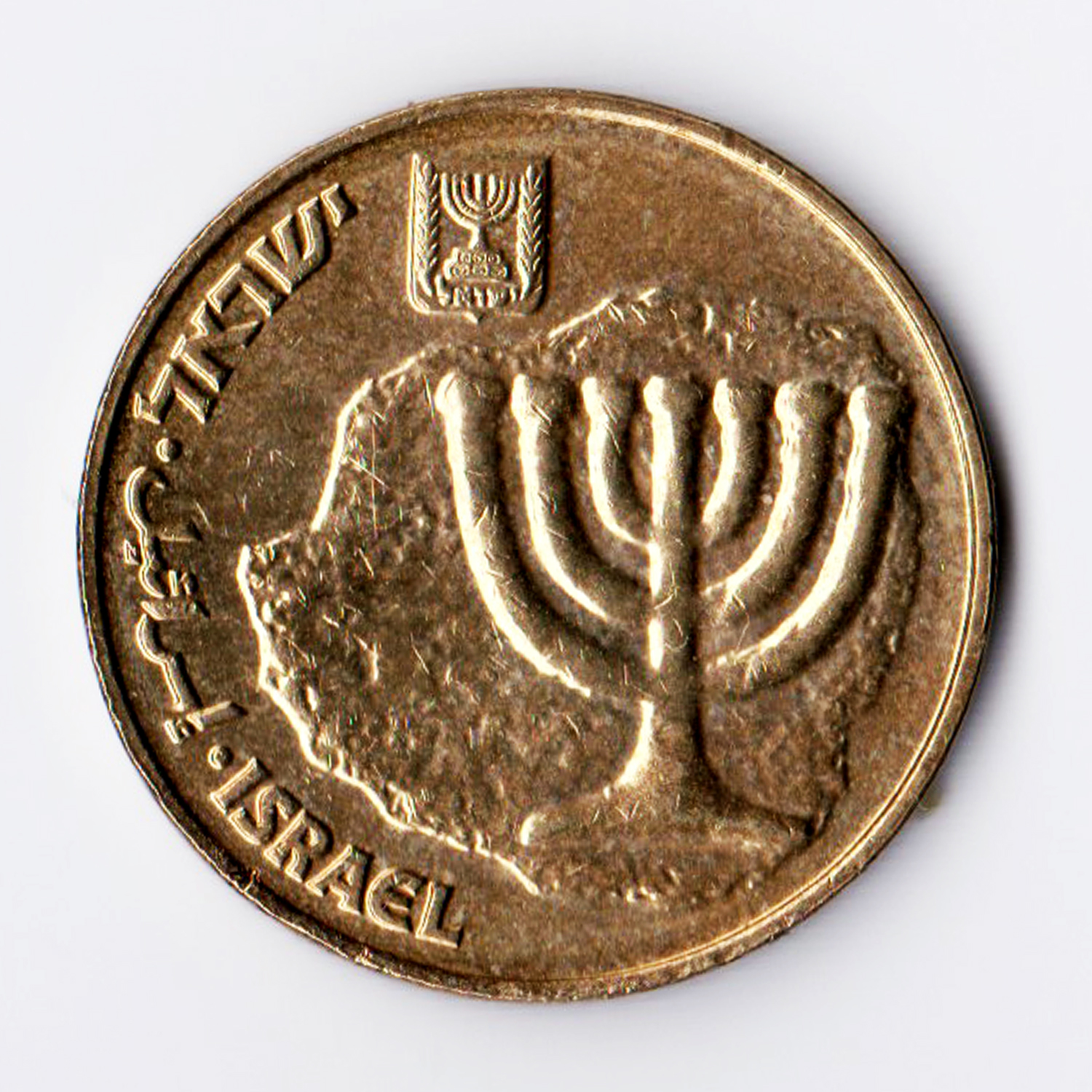
Obverse (Image 2) — a replica of a coin issued by Antigonus II Mattathias (40–37 B.C.E.) featuring the seven-branched candelabrum (menorah), the state emblem of Israel flanked by olive branches, with “Israel” inscribed in Hebrew (ישראל), Arabic (اسرائيل), and English. The Hebrew date shown in the image (התשנ”ג) corresponds to the year 1993.
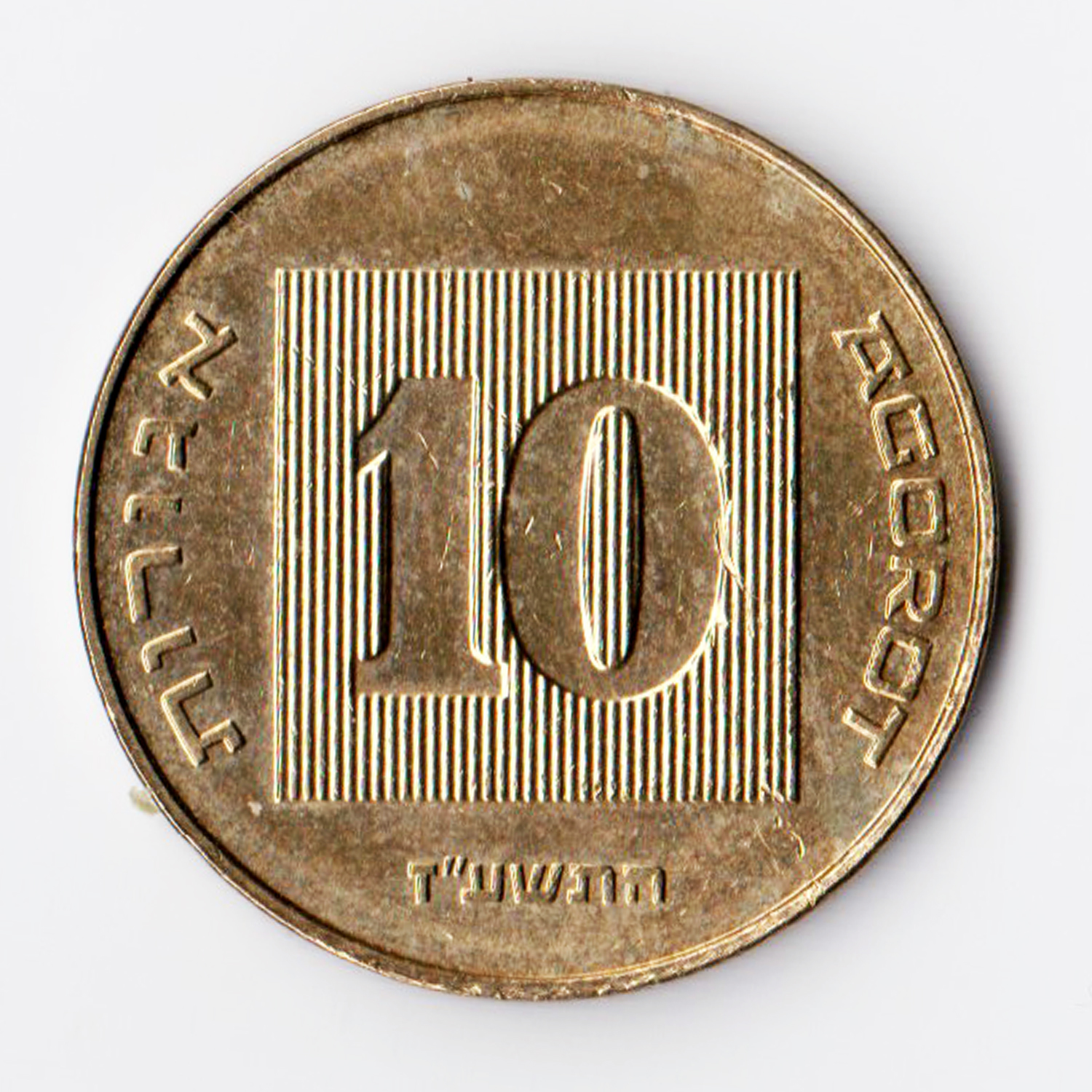
Reverse (Image 1) — the denomination “10” set within a bold geometric square of fine vertical lines, with the value written in Hebrew (“עשרה אגורות”) on the left, “AGOROT” in English on the right, and the Hebrew year date at the bottom.
Historical design — 2,000 years of history
The menorah depicted on the coin is not merely decorative. The Bank of Israel maintains that the 10 agorot design was selected for its historical value, as it is a replica of a coin issued by Mattathias Antigonus (40–37 B.C.E.) with the seven-branched candelabrum. This makes the coin a direct echo of ancient Judean coinage — bridging 2,000 years of Jewish history on a modern circulation piece.
A famous controversy
The “10 agorot controversy” refers to a conspiracy theory promoted by PLO chairman Yasser Arafat at a specially convened session of the UN Security Council in Geneva on 25 May 1990. Arafat claimed that the obverse design showed a map of “Greater Israel” representing Zionist expansionist goals. The Bank of Israel rejected this, affirming the purely historical nature of the design. The shape that resembles a “map” is in fact the ancient menorah’s base as depicted on the original antique coin.